

Walk down any supermarket aisle in Harrow or browse the shelves of London’s boutique stores, and you’re witnessing a silent revolution. The packages that catch your eye, communicate brand values, and ultimately persuade you to purchase are increasingly being born from a collaboration between human creativity and artificial intelligence. As we approach 2025, the landscape of product package design in the UK is undergoing its most significant transformation since the industrial revolution.
At KMK Studio, our packaging design team in Harrow has been at the forefront of integrating AI technologies into our creative process. What we’ve discovered is both exciting and reassuring: AI isn’t replacing designers it’s empowering them to achieve results that were previously impossible.
This comprehensive guide explores how UK businesses can leverage AI in package design while maintaining the human touch that makes brands genuinely connect with consumers.
1) Understanding the AI Design Revolution: More Than Just Automation
Many business owners mistakenly believe that AI in package design simply means faster iterations of the same old processes. The reality is far more profound. AI represents a fundamental shift in how we approach packaging from conception to shelf presence.
1) The Three Pillars of AI-Enhanced Package Design:
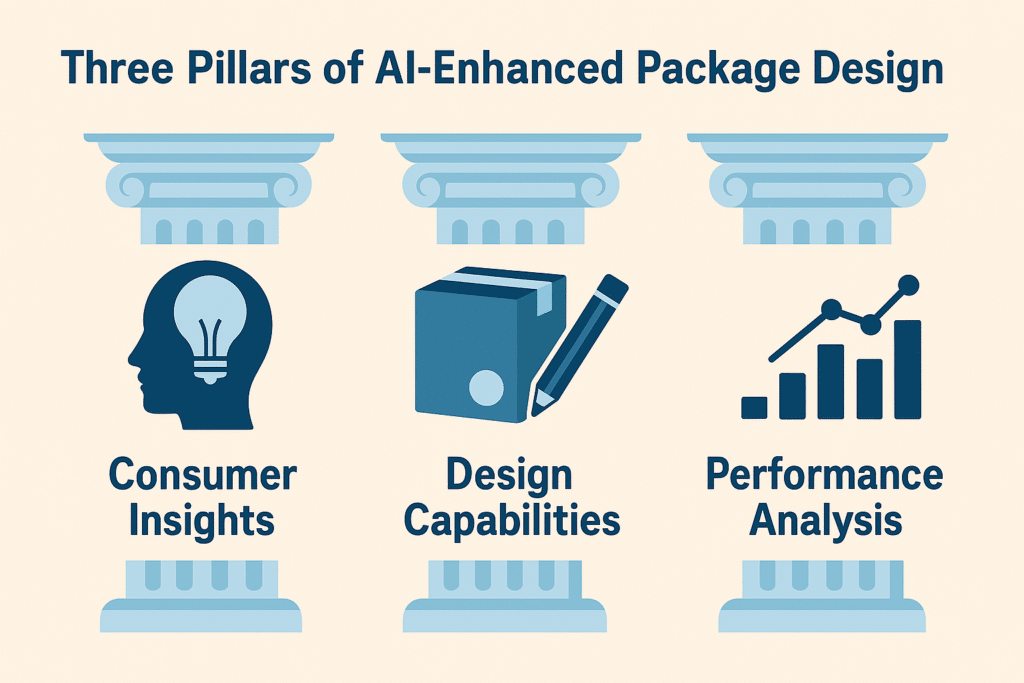
1.1) Data-Driven Consumer Insights:
Traditional package design often relied on focus groups and market research that provided limited, often biased data. AI algorithms can now analyze millions of consumer data points, social media interactions, and purchasing patterns to identify emerging trends before they become mainstream.
For UK businesses, this means packaging that resonates with local cultural nuances while appealing to broader international markets.
1.2) Generative Design Capabilities:
AI-powered tools can generate thousands of design variations based on specific parameters like brand guidelines, target demographics, and psychological triggers. This doesn’t eliminate the designer’s role but transforms it from creator to curator.
Our Harrow designers use these tools to explore creative possibilities that would take months to conceptualize manually.
1.3) Predictive Performance Analysis:
Perhaps the most game-changing aspect of AI in packaging is its ability to predict how designs will perform in real-world scenarios. Through computer vision and machine learning, we can simulate how a package will catch attention on crowded shelves, which elements consumers will notice first, and even how color schemes influence purchasing decisions.
2) The AI Toolbox: Practical Applications for UK Businesses in 2025
2.1) Market Analysis and Trend Forecasting:
Understanding the UK market has always been crucial for packaging success. AI takes this understanding to unprecedented levels. By analyzing social media trends, search patterns, and consumer behavior across different UK regions from London’s fast-paced urban centers to Harrow’s diverse community markets AI can identify subtle shifts in consumer preferences.
For instance, our analysis might reveal that consumers in the Southeast are showing increased preference for minimalist designs with sustainability messaging, while Northern markets respond better to bold colors and value propositions. This granular understanding allows for packaging strategies that feel locally relevant while maintaining brand consistency.
2.2) Sustainable Design Optimization:
Sustainability is no longer a nice-to-have feature for UK packaging it’s a consumer expectation. AI plays a crucial role in creating environmentally responsible packaging solutions through:
- Material Optimization: Algorithms can calculate the minimum material required for structural integrity, reducing waste without compromising protection.
- Lifecycle Analysis: AI can simulate a package’s entire lifecycle, from production to disposal, helping designers choose materials with the lowest environmental impact.
- Circular Economy Integration: For 2025, we’re seeing AI help design packaging that fits into circular systems, considering not just first use but potential reuse and recycling pathways specific to UK waste management infrastructures.
2.3) Personalization at Scale:
The era of one-size-fits-all packaging is ending. AI enables hyper-personalized packaging solutions that were previously economically unfeasible for most businesses. Imagine limited-edition packaging variations for different UK regions, seasonal adaptations that respond to weather patterns, or even personalized messages for specific retailer requirements.
3) The Human Touch: Why Designers Remain Essential in the AI Era:
Despite AI’s impressive capabilities, the most successful packaging solutions of 2025 will blend technological power with human creativity and empathy. At our Harrow design studio, we’ve developed a collaborative workflow that maximizes the strengths of both.
3.1) Strategic Creative Direction
AI can generate options, but it takes human expertise to determine which directions align with brand strategy and long-term vision. Our creative directors use AI as a brainstorming partner, feeding it strategic parameters and curating the most promising outputs for further development.
3.2) Emotional Intelligence and Cultural Understanding:
While AI can analyze data about consumer preferences, it cannot truly understand human emotions, cultural nuances, or the subtle storytelling that transforms a package into a brand experience. This is particularly important in the diverse UK market, where packaging must resonate across different cultural contexts.
3.3) Ethical Oversight and Brand Safety:
AI models can sometimes produce unexpected or inappropriate results based on their training data. Human designers provide crucial oversight, ensuring that packaging designs maintain brand values and avoid potential missteps in cultural sensitivity or messaging.
4) Implementing AI in Your Packaging Strategy:
4.1) Assessing Your Readiness:
Before diving into AI-powered packaging, businesses should evaluate their current capabilities and infrastructure. Key considerations include:
- Data Collection: Do you have systems to gather consumer insights and performance data?
- Team Skills: Are your designers comfortable working with AI tools?
- Budget Allocation: AI implementation requires investment in both technology and training
- Strategic Goals: How can AI specifically address your packaging challenges and opportunities?
4.2) Choosing the Right Tools:
The market for AI design tools is expanding rapidly. Based on our experience at KMK Studio, we recommend:
- For Small to Medium Businesses: Start with accessible platforms that offer AI-assisted design features without requiring significant technical expertise.
- For Enterprise-Level Operations: Consider custom AI solutions trained on your specific product categories and market data.
- For All Businesses: Prioritise tools that integrate with your existing design workflows rather than requiring complete process overhaul.
4.3) Developing a Phased Implementation Plan:
Sudden, wholesale adoption of AI often leads to frustration and wasted resources. We recommend a structured approach:
Step 1: Exploration and Education (Months 1-3)
- Identify specific packaging challenges AI might solve
- Train team members on basic AI concepts and tools
- Run small-scale pilot projects
Phase 2: Integration and Optimization (Months 4-9)
- Incorporate AI tools into standard design workflows
- Develop metrics to measure AI’s impact on design efficiency and effectiveness
- Refine processes based on initial results
Phase 3: Expansion and Innovation (Month 10+)
- Explore advanced AI applications like predictive analytics and generative design
- Consider developing proprietary AI tools tailored to your specific needs
- Share learnings across the organisation
5) Packaging Trends for UK Businesses in 2025:
Based on our work with clients across Harrow and the wider UK market, several key trends are emerging for 2025:
5.1) Smart Packaging Integration:
Packaging is becoming interactive through QR codes, AR triggers, and NFC technology. AI helps design these elements to feel integrated rather than added as an afterthought. For UK consumers increasingly concerned about product authenticity and origin, smart packaging provides transparent supply chain information at a tap.
5.2) Dynamic Adaptation:
Static packaging is giving way to designs that can adapt to different contexts. AI enables versions for seasonal promotions, limited editions, or even real-time responses to market events. This flexibility is particularly valuable in the unpredictable post-BreUK UK market.
5.3) Hyper-Localized Variations:
While maintaining brand consistency, packaging can now feature subtle variations for different UK regions. AI analyses local preferences, cultural references, and even climatic conditions to optimise packaging for specific markets without compromising brand identity.
5.4) Sustainability as Standard:
AI-driven lifecycle assessment is making truly sustainable packaging accessible to businesses of all sizes. Beyond materials, AI helps optimise shipping configurations to reduce carbon footprint—a growing concern for UK consumers and regulators alike.
Blending AI Efficiency with Human Creativity in Harrow:

At our Harrow design studio, we’ve developed a unique methodology that harnesses AI’s power while preserving the creative magic that makes packaging memorable.
Our AI-Enhanced Workflow:
- Discovery Phase: We use AI to analyse your market position, competitor packaging, and consumer sentiment, providing data-driven insights that inform our creative strategy.
- Concept Development: Our designers work with generative AI tools to explore hundreds of creative directions quickly, then apply their expertise to refine the most promising concepts.
- Testing and Validation: Before finalising any design, we use predictive analytics to simulate shelf impact and consumer response, reducing the risk of market failure.
- Implementation and Adaptation: We monitor packaging performance post-launch, using AI to identify opportunities for optimization and iteration.
Why Harrow Businesses Choose Our Approach:
- Local Understanding, Global Perspective: Based in Harrow, we understand the nuances of the UK market while maintaining awareness of international trends.
- Technology with a Human Face: We invest in the latest AI tools but never lose sight of the emotional connection that makes packaging truly effective.
- Proven Results: Our AI-enhanced packaging designs have demonstrated measurable improvements in shelf impact, brand recognition, and sales conversion for clients across multiple sectors.
Navigating the Ethical Landscape of AI in Package Design:
As AI becomes more integrated into packaging design, ethical considerations grow in importance. At KMK Studio, we adhere to strict principles:
- Transparency: We’re clear with clients about how and when we use AI in our processes.
- Data Privacy: Consumer data used to train AI models is anonymised and secured according to UK GDPR standards.
- Avoiding Manipulation: We use AI to create better packaging, not to employ dark patterns or psychological manipulation.
- Sustainability Commitment: Our AI implementations prioritise environmental responsibility throughout the packaging lifecycle.
Preparing for the Future: Next Steps for Your Business
The integration of AI into package design isn’t a distant future—it’s happening now. UK businesses that embrace this transformation will gain significant competitive advantages in efficiency, consumer connection, and sustainability.
Immediate Actions You Can Take
- Educate Your Team: Begin exploring AI design tools and concepts relevant to packaging.
- Audit Your Current Packaging: Identify areas where AI could provide immediate improvements.
- Start Small: Implement AI in one aspect of your packaging process rather than attempting complete transformation.
- Partner with Experts: Consider working with agencies like KMK Studio that have already navigated the learning curve of AI integration.
The Harmonious Future of AI and Human Creativity:
The most successful packaging of 2025 won’t be created solely by humans or algorithms but through the powerful collaboration between both. AI handles the data analysis, pattern recognition, and rapid iteration, while human designers provide strategic direction, emotional intelligence, and creative brilliance.
For UK businesses, this represents an unprecedented opportunity to create packaging that’s not just visually appealing but deeply connected to consumer needs, environmentally responsible, and commercially effective. The future of package design is intelligent, adaptive, and sustainable—and it’s available to businesses of all sizes, right here in Harrow and across the United Kingdom.
At KMK Studio, we’re excited to help businesses navigate this new landscape, combining cutting-edge AI tools with the timeless power of human creativity to build packaging that doesn’t just contain products but communicates values, builds relationships, and drives growth.